
Access to High-Quality Child Care Continues to Get More Scarce
April 9, 2026 | Written by Kim Kofron, Executive Director of Early Childhood Education, and Jacob Westjohn, Associate Director of the Center for Social Measurement & Evaluation, CHILDREN AT RISK
(Note: Data sources are all publicly available from the Texas Workforce Commission, Texas Education Agency (TEA), and Human Services Commission. This report uses data from October 1st, 2024-September 30th 2025.)
Texas Child Care Landscape
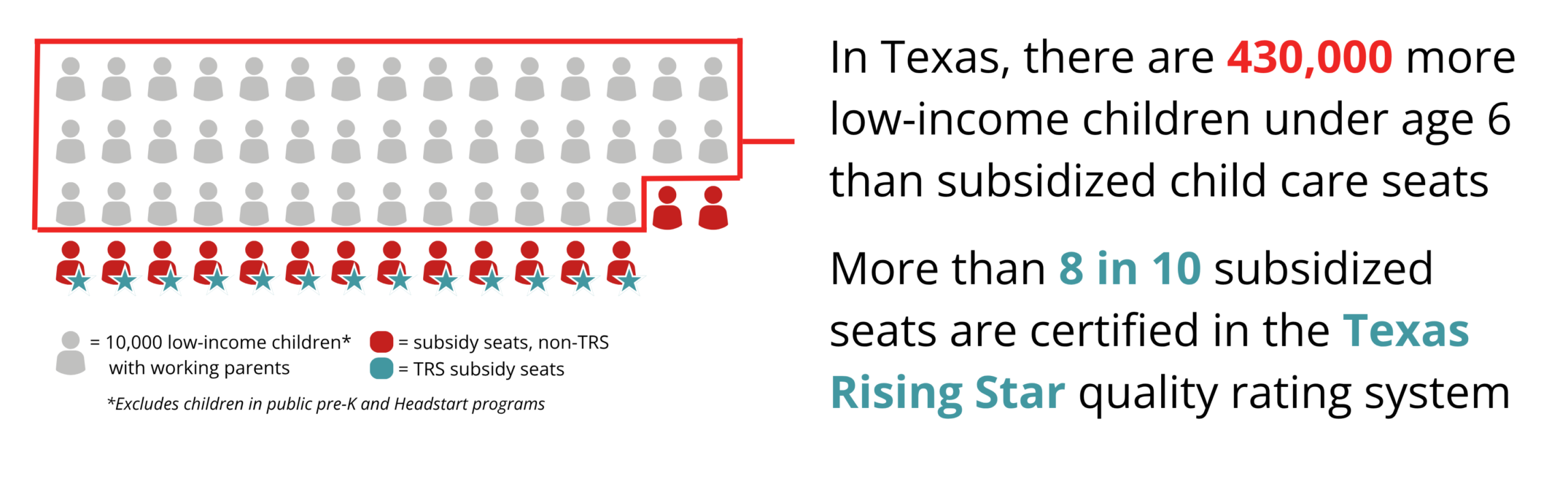
Access to quality child care for low-income families in Texas keeps getting harder. This year’s analysis finds that 76.0% — roughly 441,000 low-income children under age 6 with working parents — live in a subsidized Child Care Desert. These are zip codes where demand for subsidized care is at least three times greater than the available supply of licensed seats. Four of every five low-income children in Texas live in a zip code that is considered a Texas Rising Star (TRS) desert, limiting their access to high quality, affordable early education.
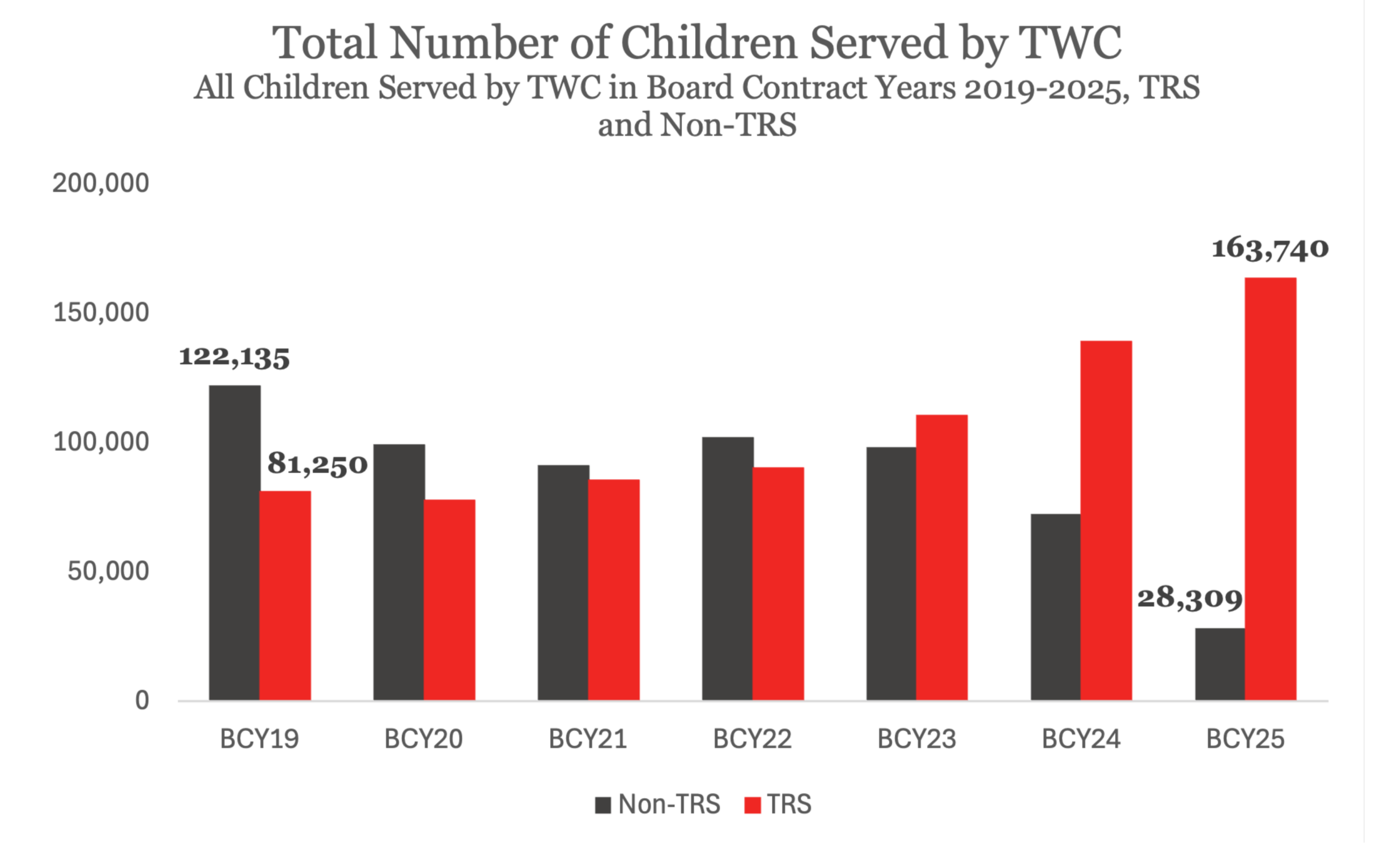
Nearly 60% of licensed child care providers, more than 6,800 centers and homes, participate in the Texas Workforce Commission’s child care subsidy system. Yet growth in that system has been limited, with only 60 new providers added in the past year. Statewide, there are 148,675 subsidized seats and 132,064 Texas Rising Star–certified seats — serving a population of more than 500,000 low-income children under age six with working parents. The total number of licensed capacity seats in Texas is about 995,000.
Among providers participating in the subsidy system, Texas Rising Star (TRS) certification saw significant growth this year, increasing from 46% to 74% — a 28 percentage point gain and nearly 2,000 newly certified providers. As a result, nearly three in four subsidy providers now meet TRS quality standards, compared to fewer than half just one year ago.
This growth was seen across all workforce board areas, though at varying rates. Regions such as Cameron, Concho Valley, and the Lower Rio Grande Valley experienced increases of more than 40 percentage points, while areas like Brazos Valley, the Heart of Texas, and the Panhandle saw more modest gains. Despite this progress, Golden Crescent remains an outlier, with only 40% of subsidy providers meeting TRS standards in 2026.
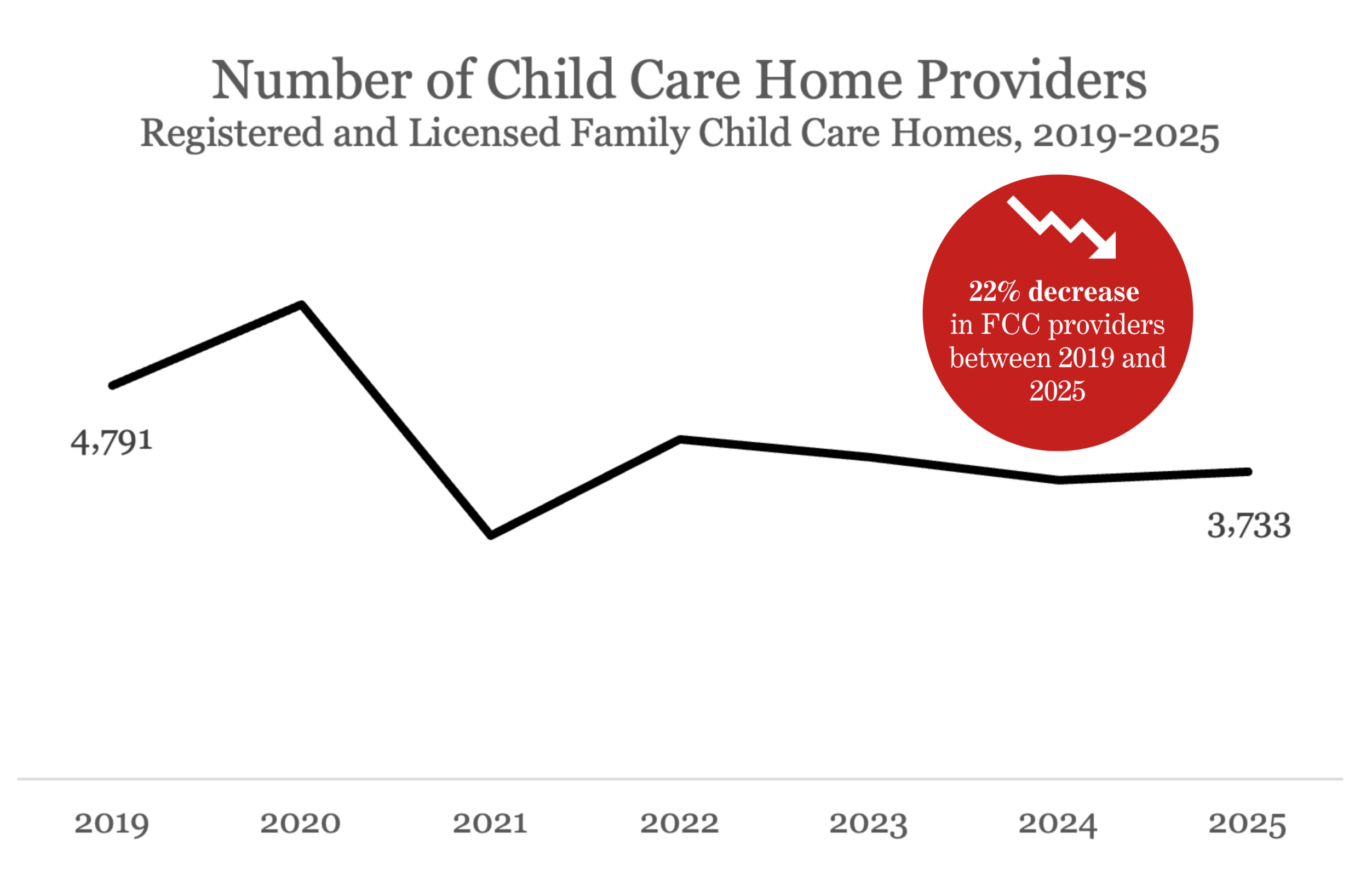
Family child care homes have been a critical piece of the puzzle for infants, toddlers, and families with nontraditional schedules. They’re also part of the early education system under the most strain. Registered and licensed family child care homes alike are struggling to bounce back from losses seen during the COVID-19 pandemic, and that thinning supply has hit hardest in the communities that most need affordable options. However, this year, we saw the number of licensed and registered family child care homes improve from 3,638 to 3,733 (+95), though this figure is still 22% below 2019 levels.
Child Care Deserts in Texas
Every year, CHILDREN AT RISK analyzes child care supply and demand across every zip code in Texas to identify where families simply can’t find adequate care. A zip code is a child care desert if the number of children under age 6 with working parents exceeds three times the licensed capacity of local providers. Subsidy deserts apply that same threshold to subsidized capacity, and Texas Rising Star deserts to TRS-certified capacity.
You can explore our Texas child care desert map here.
As of September 2025, there are 413 Child Care Desert zip codes across Texas—slightly fewer than last year. But, for low-income working families who need care, the situation is getting worse. There are now 884 Subsidy Child Care Deserts, an increase of 106, and 938 Texas Rising Star (TRS) deserts—88 more than last year. In fact, 81% of low-income children with working parents live in areas without access to high-quality TRS care.
These trends aren’t just about having too few providers or too many children. While the number of high-quality, TRS-certified programs has grown and the overall child population has stayed relatively stable, demand is rising faster than supply as communities are experiencing a growth in low-income populations.
What this means is that new child care options are often opening in areas that already have some access, while high-need communities, particularly rural and low-income areas, are being left behind.
Overall, about 195,000 children with working parents live in a child care desert. For low-income families, the numbers are even more stark: nearly 441,000 children are in subsidy deserts, and nearly 469,000 lack access to high-quality care. For many families in Texas, finding affordable, quality child care close to home simply isn’t an option.
Chronic Child Care Deserts
This year, CHILDREN AT RISK introduced a new way to look at child care access: Chronic Child Care Deserts. These are zip codes that have been classified as Child Care Deserts for three years in a row. While a single year snapshot shows where gaps exists today, this measure highlights communities where shortages are persistent and not trending toward resolution quickly.
Across Texas, 263 zip codes now meet this definition, meaning 64% of all child care deserts are considered chronic. The trend is similar for families needing affordable and high-quality care: 558 subsidy deserts and 635 Texas Rising Star (TRS) deserts have remained deserts for three consecutive years. In fact, chronic subsidy deserts saw the largest increase this year, growing by 113 zip codes.
These patterns show that in many parts of Texas, especially rural regions like Brazos Valley, Deep East Texas, East Texas, and Northeast Texas, child care shortages are not new—they are ongoing. In some of these areas, more than half of child care deserts have persisted for at least three years. At the same time, other regions have fewer chronic deserts, but still face access challenges, suggesting that shortages may be newer or shifting.
For hundreds of communities across Texas, the reality is clear: access to child care isn’t improving with time. For many families, the lack of affordable, quality care has been a consistent challenge year after year.
To learn more about which zip codes in your community are considered Chronic Child Care Deserts, download the data here.
Summary and Call to Action
Last year, the increase in Texas Rising Star certified providers offered reason for optimism, and that progress continued into 2026, with nearly three in four subsidy providers now meeting TRS standards. But higher certification rates alone don’t tell the full story. In many high-need communities, the number of low-income children is growing faster than the supply of subsidized and high-quality seats. As a result, child care deserts for low-income families continue to expand, and the new chronic desert data show that these gaps have persisted for years.
While more providers are participating in the system, those gains are not reaching the communities that need them most. Ongoing underfunding, especially within the subsidy system, limits where providers can operate and what they can sustain. Families left without options are often those least able to absorb the cost of care.
At the same time, Texas has an opportunity to address these challenges. The Sunset review process and the Governor’s Task Force on Early Childhood Education and Care (ECEC) offer a critical moment to strengthen the child care system by investing in providers, expanding access for families, and directing resources to communities where shortages have become long-standing.
As policymakers look into early childhood education during the interim, the Texas Sunset review process, and the recommendations coming out of the Governor’s ECEC Task Force, CHILDREN AT RISK urges the following:
1. Invest meaningfully in child care through direct reimbursement rates, workforce support, and supply-building in chronic desert communities;
2. Use the Sunset review process to strengthen accountability and coordination across state agencies, such as Texas Workforce Commission, Health and Human Services Commission, responsible for child care access and quality;
3. Expand access to child care scholarships and reduce administrative barriers for eligible families;
4. Use Chronic Desert zip codes as a targeting tool in Local Workforce Board planning and quality investment strategies.
Chronic Child Care Deserts aren’t inevitable. They’re the predictable outcome of a system that’s been underfunded for decades. The Chronic Desert data provides a new way to see where sustained investment matters most. The Governor’s ECEC Task Force, the Sunset process, and the current interim together represent an opportunity to make meaningful, lasting improvements for Texas children and families now.
Stay Informed
Sign up for our Early Education Statewide newsletter for updates during the interim, our latest research, policy analysis, and ways you can take action!
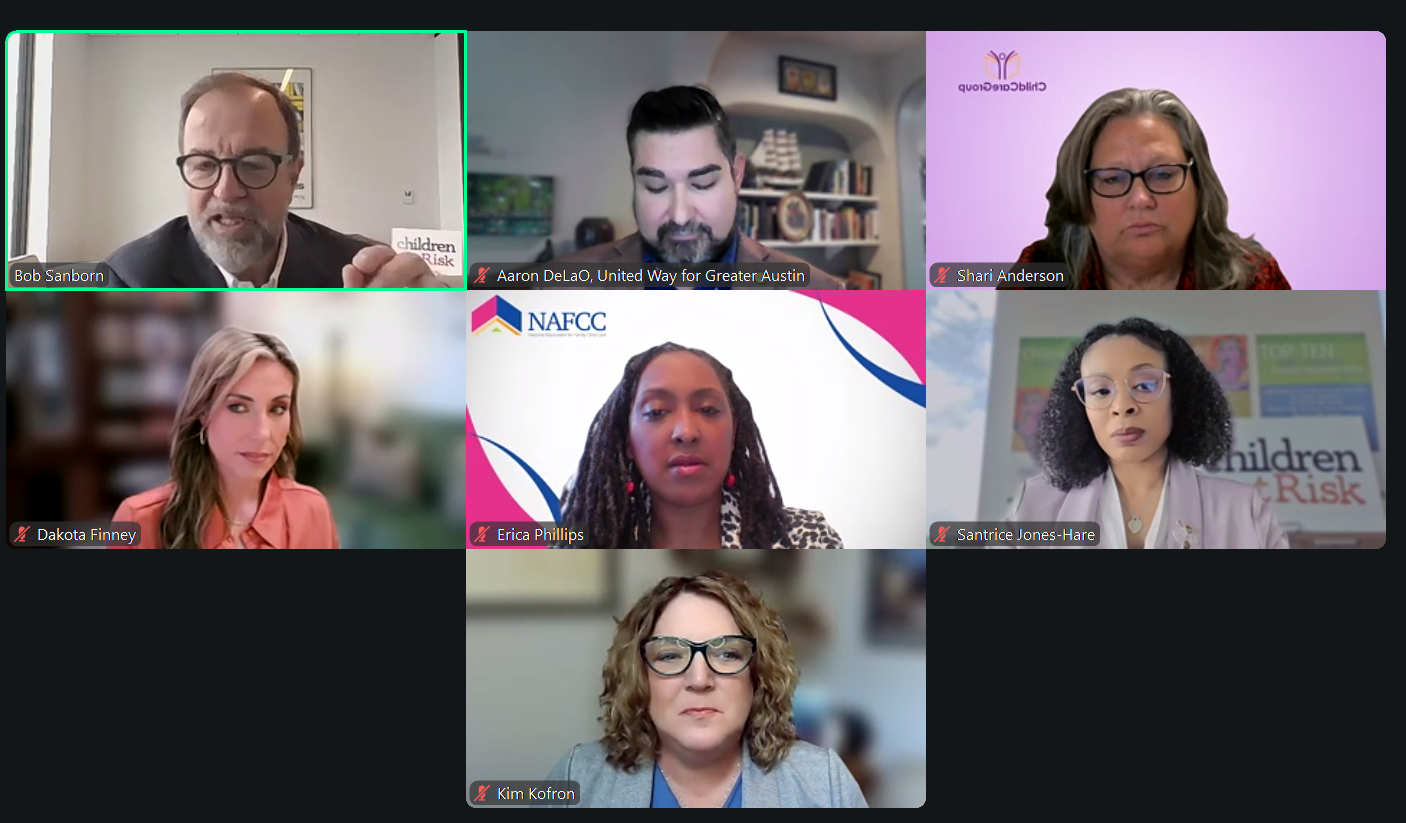
Thursday, April 9th, C@R Hosted a Virtual Press Conference to Share Key Findings
FEATURING
Dr. Bob Sanborn, President & CEO, CHILDREN AT RISK
Kim Kofron, Executive Director of Early Childhood Education, CHILDREN AT RISK
Erica Phillips, Executive Director, National Association for Family Child Care (NAFCC)
Aaron DeLaO, Chief Early Childhood & Advocacy Officer, United Way for Greater Austin
Dakota Finney, Executive Director, Little Rascals Learning Centers & Board Member, Champions for Children
Shari Anderson, Vice President, Child Care Assistance, ChildCareGroup
Santrice Jones-Hare, Director of Greater Houston Strong Start Alliance, CHILDREN AT RISK
MEDIA CONTACTS
Morgan Gerri, 832.600.9354
Rashena Franklin, 713.301.4577
READ MORE FROM C@R

2022-2023 CHILDREN AT RISK’s Annual School Rankings
For the past nineteen years, CHILDREN AT RISK (C@R) has ranked and graded Texas public schools to help parents, educators, and community members better understand how their local schools are performing. By providing this information to parents and educators, C@R hopes...
2024 C@R Learning Events
Learning Eventsconvening for change CHILDREN AT RISK is committed to hosting free events that engage the public and help them drive change for children. We aim to share research, unpack pressing policy issues, and highlight diverse community perspectives from across...

CHILDREN AT RISK Hosts The STEM Summit
Our last summit of the year will dive into the issues of STEM education, focusing on building a robust and qualified pipeline of professionals. A learning opportunity for educators and community leaders, this event will highlight the work of STEM industry leaders, educators, and nonprofit innovators working to improve access to STEM education for all students. Attendees will leave with a better understanding of what they can do to support the next generation of STEM professionals.
CHILDREN AT RISK Hosts The State of Latine Children Summit
The 2023 State of Latine Children Summit hosted on October 12th, 2023. Welcome remarks were provided by the emcee of the event, Dalinda Gonzalez- Alcantar, President of the Boys & Girls Club in McAllen. “Much of the Latin Population is concentrated in...

Fall 2023 Texas Tour Recap
Kaitlyn Newell, Associate Director of Early Education, speaks to a group of child care providers, policymakers, and business leaders in Midland, TX. Source: CHILDREN AT RISK(TX – November 16, 2023) – Each Fall the CHILDREN AT RISK Early Childhood Team sets out on our...
Harris County Commissioners Court Boosts Early Learning Initiatives with Child Care Quality Improvement Grants
Harris County Commissioners Court Boosts Early Learning Initiatives with Child Care Quality Improvement Grants The Harris County Early Learning Quality Networks Grants Empower Local Organizations to Amplify Their Voice in Education. (Harris County – October 19,...

ECE Texas Tours – Fall 2023
Throughout the month of October, CHILDREN AT RISK will be hosting community conversations across 12 cities in Texas, discussing the effects of the 88th Regular Legislative Session on Early Childhood Education and next steps for continuing to build a robust child care...

How did Children Fare in the 88th Texas Legislative Session?
Over the 140 days of the 2023 Regular Texas Legislative Session, approximately 11,800 bills were filed, and 4,550 passed. CHILDREN AT RISK showed up strong, registering support for bills 79 times, and providing expert testimony on legislation 29 times. In addition to...
Stay Engaged
Sign up to receive regular updates from our Early Childhood Education team.
Join us for local insights during the Spring 2026 Texas Tour.