
Rooted in Community: A Community Forum Uplifting Home-Based Child Care Conversations to Strengthen Early Care and Education
CHILDREN AT RISK and Harris County Department of Economic Equity & Opportunity’s Early Learning Quality Network (ELQN) brought together leaders, providers, and advocates from across Texas for their Rooted in Community event, a forum focused on strengthening early care and education and elevating the role of home-based child care.
March 17, 2026 – CHILDREN AT RISK and Harris County Department of Economic Equity & Opportunity’s Early Learning Quality Network (ELQN) brought together leaders, providers, and advocates from across Texas to focus on strengthening early care and education across Harris County. Supported through funding by Home Grown, this forum sought to uplift the voices of those too often left out of strategic conversations – home-based child care providers.
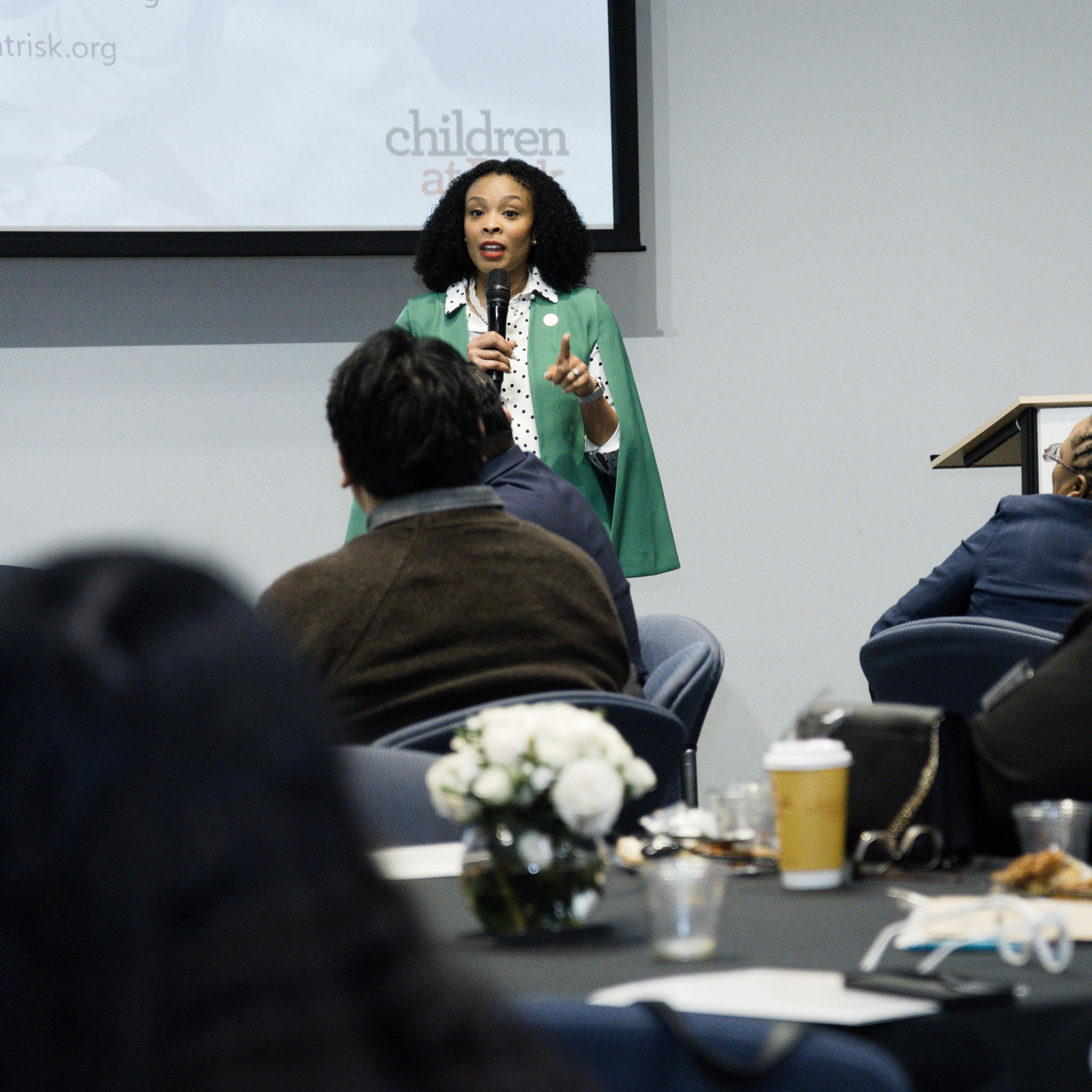
Kim Kofron, Executive Director of Early Childhood Education with CHILDREN AT RISK, opened with data on the current child care landscape in Harris County. Harris County is home to an estimated 243,000 children under the age of 6 – representing 26% of all children in Texas. While Houston hosts 24.1% of all the child care seats available in the Gulf Coast Local Workforce Development Board (LWDB), it is also the center of 32.6% of the LWDB’s Child Care Deserts, zip codes where the need for child care is 3x greater than the total seats available to low-income working families.
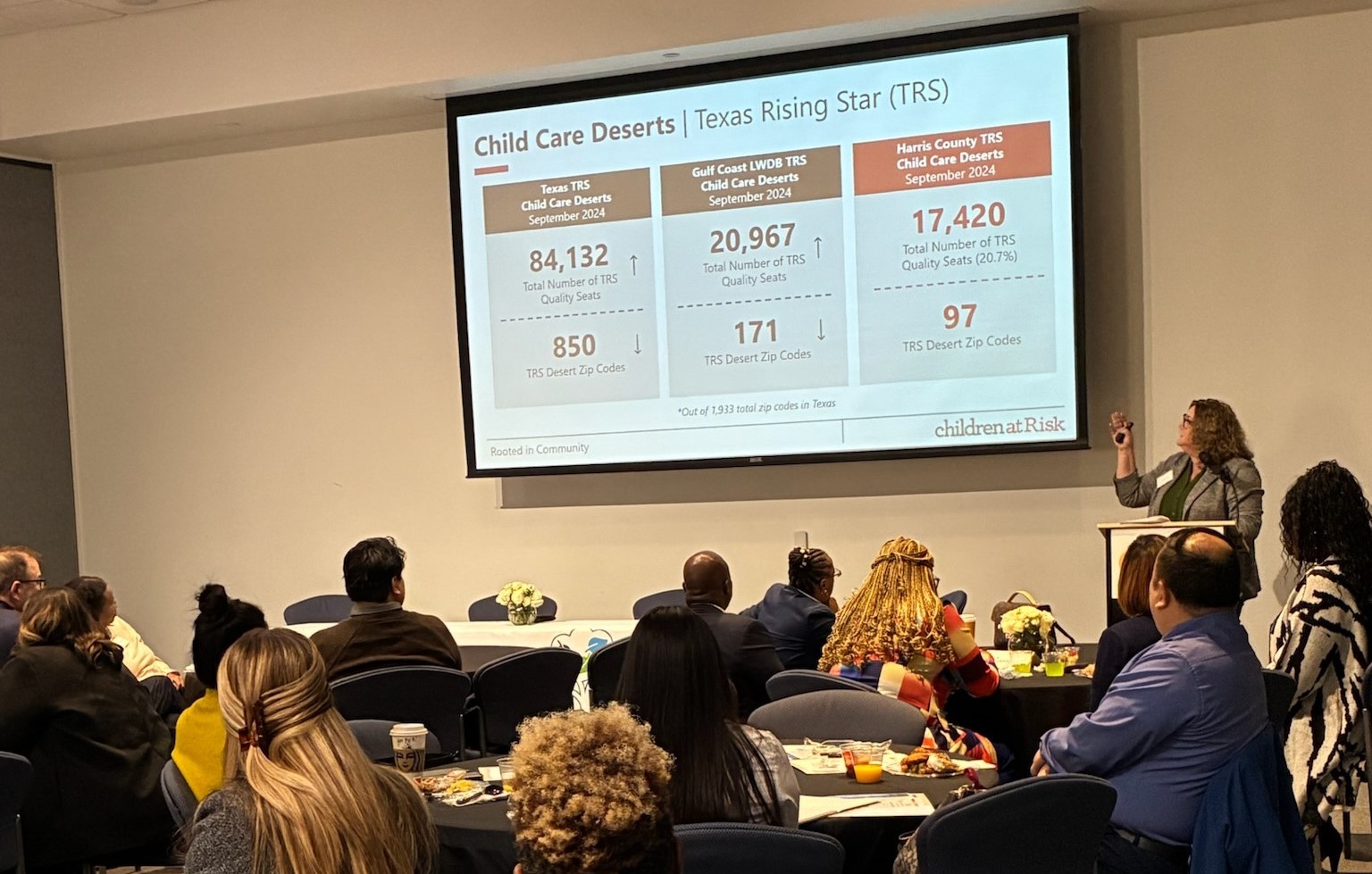
Kim Kofron provides a data overview on the status of child care across Houston, as it relates to Harris County and Statewide measures of availability and quality.
Through American Rescue Plan Act (ARPA) funding and with support from Harris County Department of Economic Equity and Opportunity (DEEO), local initiatives have been launched to increase the quality and availability of child care options throughout targeted zip codes. As this funding closes in the coming months, stakeholders are focused on how to sustain and build on progress that has been made.
Two trends emerged through Kofron’s data overview: quality within the system has improved in recent years, particularly through programs like Texas Rising Star enrollment efforts. At the same time, the number of home-based providers has declined since the pandemic, reducing options for families who rely on flexible and community-based care.
Embedded within the communities they serve, Houston’s network of home-based child care providers fill a notable gap for families. They are uniquely able to offer non-traditional care hours in a high-quality environment, and they provide mentorship for new parents or families who’ve shown need for additional support.
Following Kofron’s data overview were a series of panel discussions. The first, The Needs of Home-Based Child Care providers, handed the microphone directly to those working in this sector. The panel was moderated by Jerletha McDonald, National Family child care leader, Founder & CEO, ADFW Family Child Care and featured Dessie Mouton, Owner, Our New Beginning Learning Academy; Kathy Smith, Owner, Kathy’s Daycare; and Mieko Carter, Founder, Divine Footprints Family Childcare.
Despite their important role in Houston’s child care ecosystem, home-based child care providers face unique challenges that increase their risk of closure or financial instability compared to larger, center-based operations.
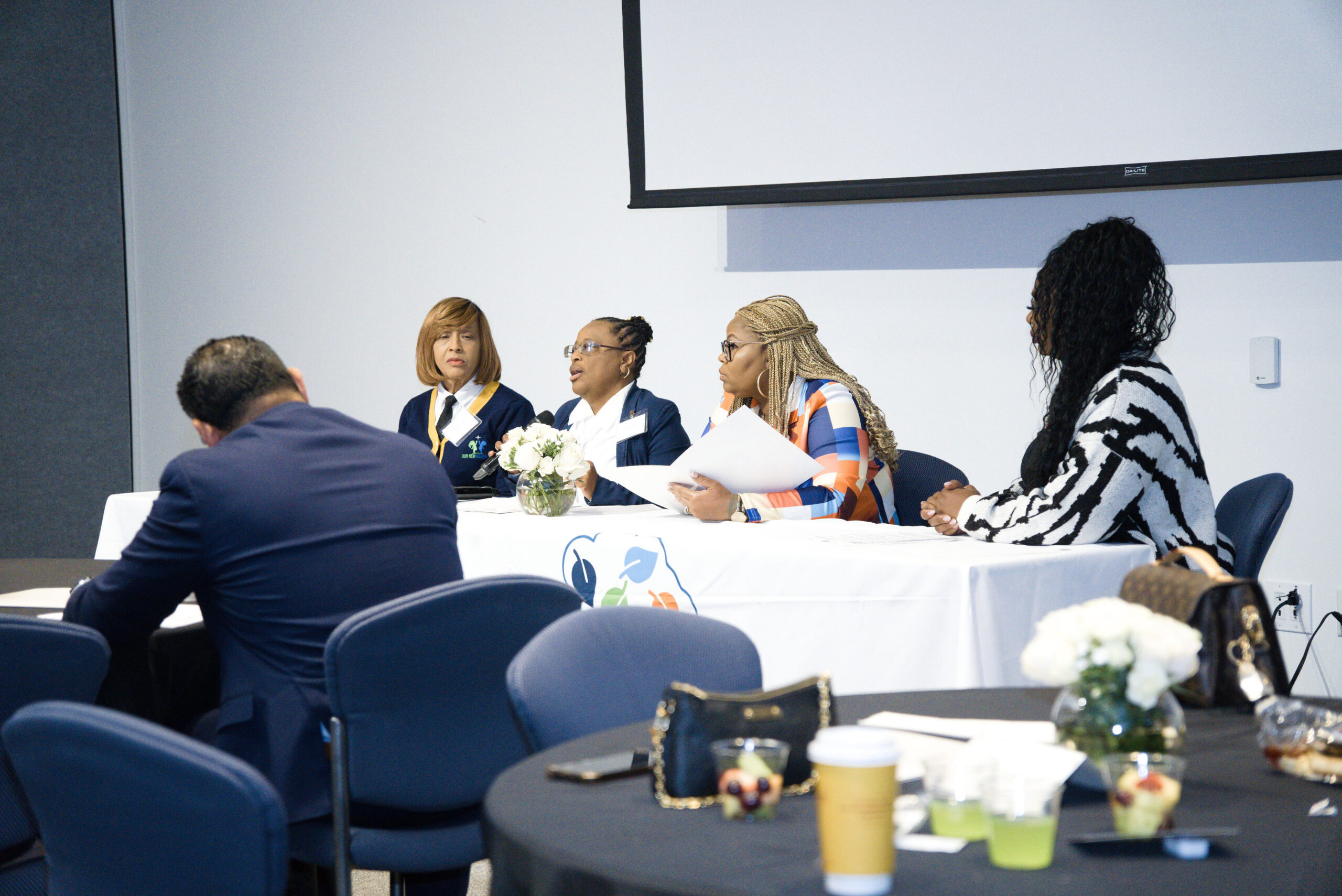
Kathy Smith shares about her experience as a home-based child care provider in Harris County during a panel discussion moderated by Jerletha McDonald. Co-panelists Dessie Mouton and Mieko Carter look on in agreement.
Photo courtesy of Jerletha McDonald & Imani Phillips
“As a provider, we prepare a lot of things for regulations, for our children being sick, for natural disaster,” said Mieko Carter. “But one thing we don’t prepare for is ourselves as a provider. A lot of centers close down because we’re not prepared… If you face an emergency and have to close your center, you need to be able to bounce back from that.”
Speakers on this panel also clarified the scope of their work, both as educators and as small business owners. They emphasized that their programs are structured, regulated, and focused on early learning outcomes, and described the level of support they provide to families beyond the classroom.
“We’re not babysitters. We’re child care providers. We are professionals in what we do,” said Kathy Smith, who is not only a TRS 4-star home-based provider but an advocate who is active in supporting her community. “We invest so much in these children. We want to make sure we teach them – no child left behind.”
“We’re their psychiatrist. We’re their spiritual leaders, we’re their support. We’re holding their hands when they don’t know what to do,” said Dessie Mouton.
Providers also outlined the challenges they are navigating in a post-pandemic world. They expressed the need for supports as they see increasing enrollment of children with undiagnosed developmental delays and behavioral needs.
“Since the pandemic, we’ve had an increase in undiagnosed children,” said Dessie Mouton, sharing that where she may have cared for one child with learning delays or special needs 10 years ago, now almost half of her class need additional support. “I’m up at night researching, calling people – How can I help these children, how can I help this family? For us, it’s not just a job. It’s reaching out to fill a gap.”
The conversation then shifted to a systems-level discussion. What needs to be done to support home-based child care?
Dr. Bob Sanborn, President & CEO of CHILDREN AT RISK, moderated a conversation exploring this question with Texas State Representative Armando Walle, Texas House District 140; Jacinth Chapman, Senior Manager, Early Education Quality, Workforce Solutions, Gulf Coast Workforce; Makia Thomas, Program Officer, The Powell Foundation; and Estevan Delgado, Senior Program Officer, Rockwell Fund, Inc.
Panelists representing state government, philanthropy, and workforce systems highlighted recent investments and targeted initiatives to support providers.
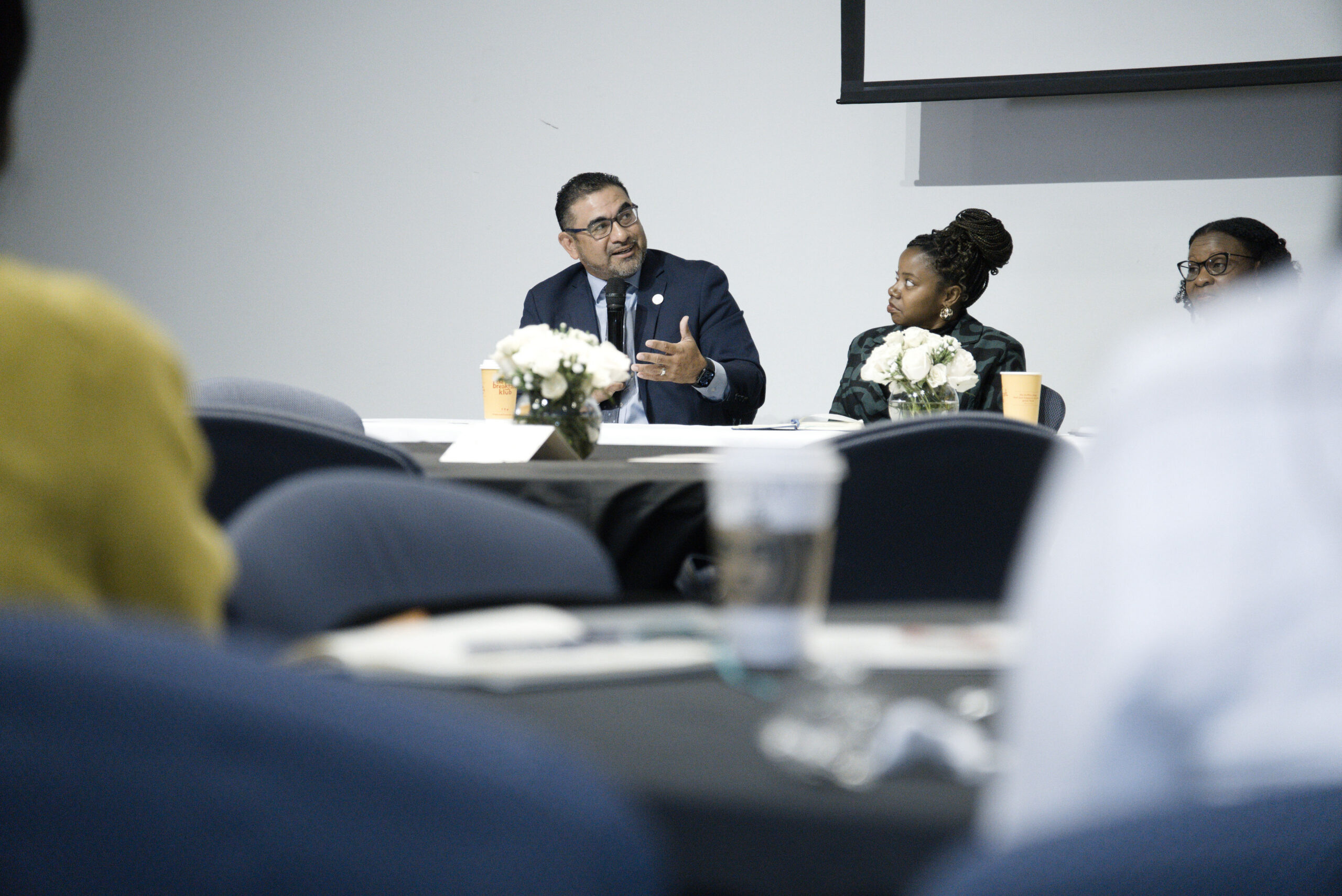
State Representative Armando Walle shares his perspective alongside fellow panelists Makia Thomas, Jacinth Chapman, and Estevan Delgado during a leadership roundtable moderated by Dr. Bob Sanborn.
Photo courtesy of Jerletha McDonald & Imani Phillips
“It will take not one entity, not two entities, but each and every one of us,” Santrice Jones-Hare, Director of the Greater Houston Strong Start Alliance with CHILDREN AT RISK, said as she opened the forum as the event’s Master of Ceremonies.
Recognizing that child care is closely tied to workforce participation and local economic stability, particularly for families working outside traditional hours, they outlined emerging priorities that included:
- Aligning funding with provider-identified needs
- Expanding access to specialized training and technical assistance
- Strengthening the business sustainability of child care providers
- Ensuring home-based care is fully integrated into planning and policy decisions
“Houston’s voice needs to be louder,” said Makia Thomas, Program Officer with the Powell Foundation.
She encouraged community members and advocates to align to form a unified voice that amplified child care provider needs not only to city or regional leaders, but to a statewide level.
Remarks from State Representative Armando Walle echoed Makia’s sentiment when he called for advocates to continue speaking out at the Texas Legislature. He shared his excitement around the allocation of an additional 100$ million towards child care, and expressed his commitment to continue this work alongside the child care community.
“…It wasn’t just me in that budget process. It was people like you that came to testify. So, we’re going to need y’all to come testify [again] during the session – to give the same speeches and have the same passion. And, I know you will,” said State Representative Armando Walle.
Jacinth Chapman of Gulf Coast Workforce shared that her organization is focused on truly supporting home-based providers to ensure they can keep showing up to do this work for years to come.
“We don’t want this group of child care providers to die off or lose their way because the centers are the ones that we look at and support more often,” said Jacinth Chapman. “They wear so many different hats. They’re the owner, the director, the cook, the teacher, the social worker. We hear all about these roles and yet they don’t always get the support they need.”
“We at a foundation can strategic plan all day, but those with the lived experience are going to be able to tell us much better uh about the needs in the community,” Estevan Delgado said.
Estevan Delgado shared about efforts to direct funding toward historically underinvested communities. His work with the Rockwell Foundation has focused on channeling resources to these communities by listening to community members to do so.
“…Something came up, time and time again. Mothers would raise their hands and say “Hey, I can’t take part in the workforce because I work nontraditional hours and there’s no one to watch my child, unless I rely on family and that can be burdensome for them as well,” Delgado said. “So when we really think about this, it’s not just a child care issue, it’s an employment issue. It’s an equity issue. It’s a woman’s issue. It’s an issue for me. And it’s an issue for all of those who have different identities. And we heard this, over and over again.”
STAY CONNECTED

MORE FROM ELQN

MORE LIKE THIS

Spring 2026 | Early Childhood Education Texas Tour
Each spring, the CHILDREN AT RISK Early Childhood Education team hosts virtual community roundtables across 12 major cities in Texas. During these sessions, C@R experts will share updates from the latest Paving the Way report, including regional...

Paving the Way to Quality 2026
Analysis of Texas LWDB Fiscal Spending of Child Care Quality Investments TEXAS (January 28, 2026) - CHILDREN AT RISK has released its second analysis of Local Workforce Development Board (LWDB) spending across Texas. Focusing on investments made...

Press Release: Strong Start Launch
Strong Start: Greater Houston Early Childhood Education Alliance will transform the early childhood education sector across the Greater Houston area, addressing the growing gap in child care access throughout the Gulf Coast region. Media...

Texas Early Childhood Systems: Insights from the 2025 Fall Texas Tour
CHILDREN AT RISK visited 12 local communities throughout Texas to engage in grassroots conversations centered on data and the dynamic needs of the child care workforce. Every fall, our Early Childhood Education team packs our bags and hits the...
Two Years of Impact: Celebrating the Commitment and Progress of Harris County’s Early Learning Quality Network
OCTOBER 10, 2025 Written by Briauna Derry, Director of Media Activism, CHILDREN AT RISK Two years ago today, on October 10, 2023, Harris County Department of Economic Equity and Opportunity’s Early Learning Quality Network (ELQN) was launched with...
Frequently Asked Questions: ELQN
Why should I be a part of this early childhood program? What are the benefits for my child(ren)? ELQN is a program that was created to make sure that all children 0-8 years old in Harris County have access to high-quality childcare and educational...

Seeds of Change: Recap of the 2025 Early Childhood Education Summit
This virtual gathering brought together legislators, policy experts, state leaders, advocates, and community stakeholders to reflect on recent wins for Texas children and chart the course for the work ahead. On August 14th, CHILDREN AT RISK...


Get Involved
Our vision is for the state of Texas to be the best possible place for children to grow and families to work. CHILDREN AT RISK’s team works tirelessly to listen to community needs and advocate for public policy that truly supports Texas children and families.
Stay in touch! Sign up for our regular newsletter today to receive monthly updates on the latest research, convenings, and advocacy opportunities.
Questions? Contact us at info@childrenatrisk.org.