
Kim Kofron Provides Testimony for the Governor's Taskforce on Early Childhood Education and Care
March 31, 2026
Good morning Mr. Holt and Committee members and thank you for having me today.
My name is Kim Kofron, Executive Director of Early Childhood Education at CHILDREN AT RISK. I come before you with more than 30 years of experience in the early childhood field, including many years working directly with children and families as a child care provider here in Texas.
Child care is a complicated policy issue that intersects with parents, private businesses both big and small, and multiple state agencies. I often use the image of a tricycle to explain the complexity of our early childhood system.
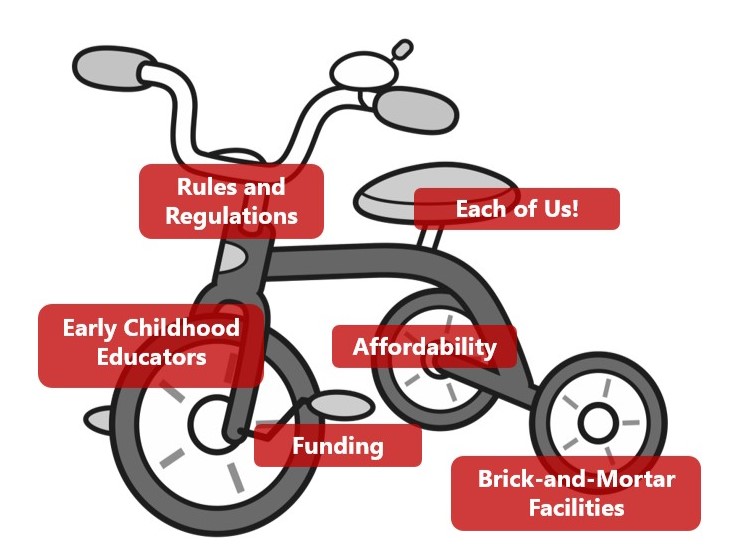
Imagine one wheel represents the programs themselves—child care centers, public school pre-K, home-based providers, faith based programs—the places where children learn and grow.
Another wheel represents the early childhood workforce—the educators who care for and teach our youngest Texans.
And the third wheel is affordability—for working parents trying to access care and for providers trying to sustain their businesses.
The frame and handlebars of that tricycle are the rules, regulations, and systems that hold everything together and help guide direction. And the pedals—those are the public and private funding streams. Because without the pedals, the entire system goes nowhere.
When all of these parts are strong and aligned, the tricycle moves forward smoothly. But too often, when we try to improve the system, we focus on just one wheel or one part. And while that may help in the short term, it often leaves us with what many of us remember from childhood—a tricycle with a flat tire. It doesn’t matter how hard you pedal—it simply won’t move the way it should.
That is where we are today.
At CHILDREN AT RISK, we work to connect what the data tells us with what families, providers, and educators experience every day. And what we see is a system that is not moving efficiently because too many parts of the tricycle are out of alignment.
To better understand these challenges, we surveyed more than 1,300 providers across all 28 workforce development areas in Texas. And twice a year, we hold a Texas Tour, going into communities to hear directly from them. You have a copy of our complete report in your packet.
Right now, families and providers are navigating a system fragmented across multiple agencies, including the Health and Human Services Commission, Texas Workforce Commission, and the Texas Education Agency – just to name a few. These agencies each play important roles—but without alignment, the result is inconsistent rules, duplicative requirements, and confusion.
And in a state as large as Texas, these challenges are magnified. We are home to 1 in 10 children in the United States, with 2.3 million children under age six. Child care is essential infrastructure—but the system is under strain.
Take affordability—that third wheel. Child care is expensive for families, but not because providers are getting rich. This is a labor-intensive system that relies on educators. Yet 43% of early childhood educators rely on public safety net programs to survive. Educators cannot afford to earn less, and families cannot afford to pay more. That wheel is under significant pressure.
Looking at the supply side—the first wheel—our data shows we lost nearly 75,000 child care seats from 2023 to 2024. We are only serving about 16% of eligible children through subsidy programs, and nearly half of all ZIP codes are child care deserts for low-income working families. That wheel is losing air quickly.
And the workforce—the second wheel—is strained by low wages, high turnover, and increasing demands tied to inconsistent regulations and administrative burden. Texas ECE Workforce is 6 times more likely to live in poverty than elementary and middle school teachers.
But the challenges don’t stop with the wheels.
The frame and handlebars—the rules and systems—are not aligned. Providers must navigate different expectations across agencies, even when serving the same children. Regulations can be interpreted differently within the same state agency as well as by different state agencies. Enforcement is inconsistent, and systems are too often disconnected and unnecessarily burdensome rather than supportive.
And the pedals—the funding streams—are not always predictable or insufficient. Delays in reimbursement, inconsistent contracting requirements, and complex processes make it difficult for providers to operate stable programs. That’s why only half of the state’s child care providers choose to participate in the state child care subsidy system.
What we heard in the survey and on the Tour reinforces this picture: they are deeply committed to children, but they are trying to operate a tricycle where too many parts are out of sync.
They described fragmented governance, inconsistent regulations, unreliable contracting systems, outdated technology, and complex application processes for working parents.
And importantly, they are not asking for less accountability. They are asking for accountability that matters and a state child care system that works together—one that is clear, consistent, and designed to support quality care.
So what does it look like to fix the tricycle?
It means strengthening coordination across agencies so the frame holds steady.
It means aligning regulations so providers are not pulled in different directions.
It means investing in the workforce so that wheel can carry its weight.
It means addressing affordability so working parents and providers can all participate in the system.
It means modernizing technology and simplifying access.
And it means ensuring funding flows efficiently so the pedals actually move the system forward.
Because when one part is weak, the whole system struggles.
But when all parts are aligned, we have the opportunity to build something strong, stable, and capable of moving Texas forward.
So as you continue this work over the coming months, I encourage you to think about the tricycle.
Ask yourselves: are we strengthening all parts of the system, or just one?
Are we building something that truly moves children and working parents, and ultimately Texas forward?
Because the goal is not just to fix a piece of the tricycle. The goal is for each of us to be in the driver’s seat of a well-built, sturdy tricycle—one where every wheel is strong, the frame is aligned, and the pedals actually move us forward.
That is the system Texas children and working parents deserve.
Thank you for your time and your commitment. I’m happy to answer any questions.