

This year, national advocates explored child-forward immigration policies, access to basic needs and mental health resources, education equity, and how to shift the narrative surrounding immigrants and immigration.
On June 23, 2022, CHILDREN AT RISK hosted their third annual National Immigration Summit to explore the challenges that immigrant children and their families face. Again convening esteemed advocates from across the nation, this year’s program examined child-forward immigration policy, access to basic needs and mental health resources, education, and strategic narrative change. This summit was generously sponsored by CLASP, Amazon, Jarritos Novamex, The Marek Family Foundation and is presented in partnership with The Children’s Partnership, Children Thrive Action Network, and the Texas Family Leadership Council.
Event emcee, Guadalupe Fernández, Director, Children’s Immigration Network at CHILDREN AT RISK, opened the virtual event with guest speaker Wendy Cervantes, Director, Immigration and Immigrant Families, Center for Law and Social Policy (CLASP) by discussing the importance of immigration policies that are focused on children.
Dr. Bob Sanborn, President & CEO, CHILDREN AT RISK and Mayra Alvarez, President, The Children’s Partnership, then presented key data that delineated economic issues and national representation of children of immigrants while emphasizing diversity within the immigration pool. Dr. Sanborn and Alvarez discussed the contributions and growth opportunities that young immigrants bring to the United States, regardless of economic disparities. Alvarez emphasized the importance of considering children of immigrants in regards to the policy-making process and their disadvantages as a result of the pandemic’s immigration restrictions.
“Trying to level the playing field for children and immigrant families is something we must prioritize as we consider their future contributions and their overall well-being today.”
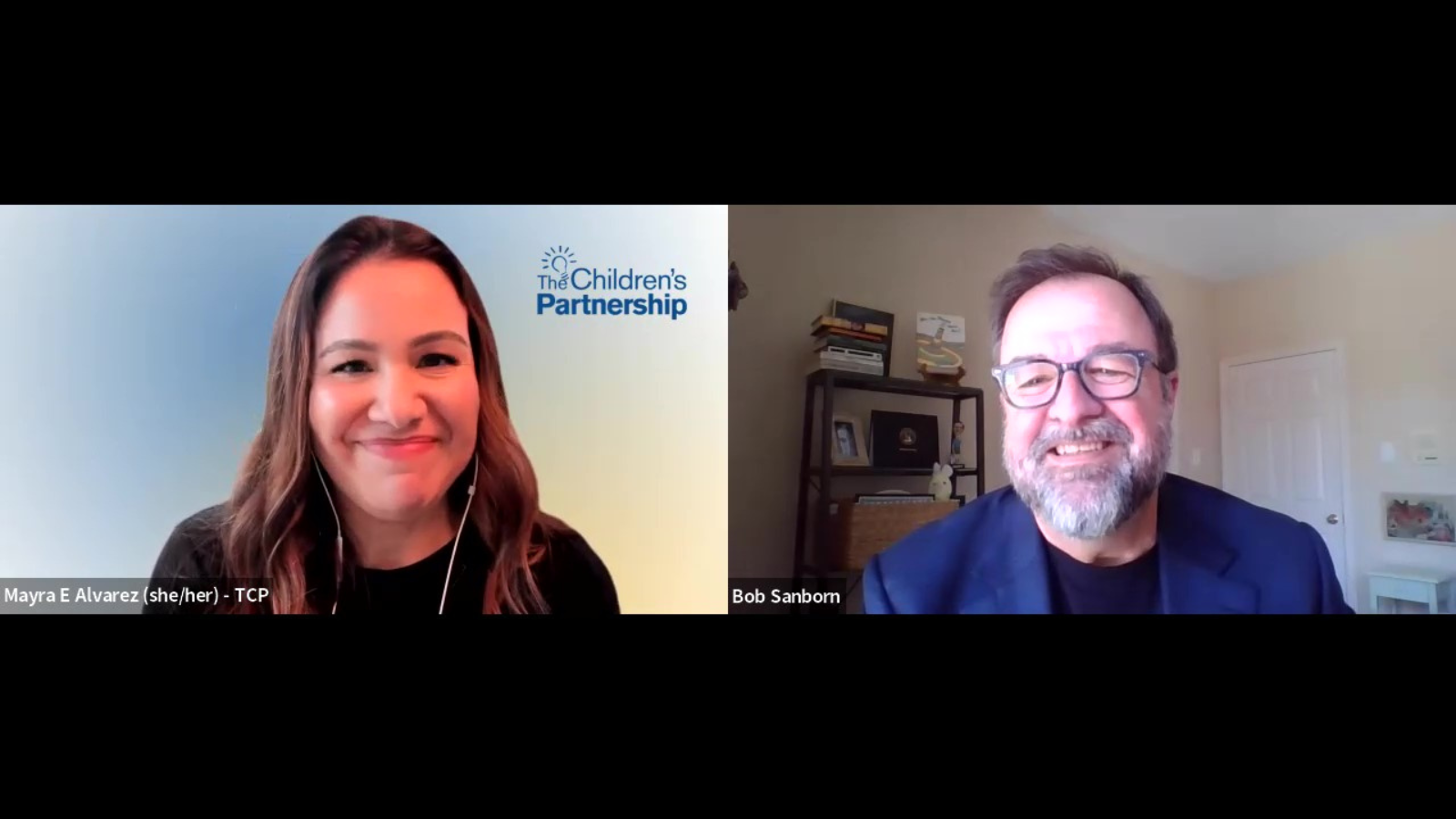
Mayra Alvarez and Dr. Bob Sanborn (C@R) provide an opening data overview about the state of immigrant children and families in America.
Moderated by Juan Carlos Gomez, Policy Analyst, Immigration and Immigrant Families with CLASP, the first session began with a panel discussion on federal immigration opportunities and challenges that children and families face. Gomez along with Bilal Askaryar, Communication Coordinator with Welcome with Dignity Campaign, Carolina Canizales, Senior Texas Campaign Strategist with Immigration Legal Resource Center, and Miriam Abaya, Vice President of Immigration and Children’s Rights with First Focus Campaign for Children discussed the barrier that the pathway to citizenship has become for immigrant families. Gomez highlighted the strength and shortcomings of the current administration’s work on the basis of immigration.
Askaryar tackled the horrific implications of Title 42 and Migrant Protection Protocols (MPP) for asylum seekers and the lack of initiative by the Biden administration to overturn these policies. Essentially, there is no functioning asylum system today. Carolina Canizales compared the Biden Administration’s strengths and weaknesses in immigration. As strengths, she commented on the moratorium on deportation, decrease in adult detention, specific prioritization of those with contact to the criminal legal system, and the Department of Homeland Security being open to individual parole cases to allow re-entry of those previously deported. On the other hand, Canizales listed weaknesses that formed a longer list centered around issues between federal and state level enforcement. Abaya addressed the Biden Administration’s steps toward opening up benefits for immigrants and the improvements to public charge rules.
This was followed by a second panel discussion, comprised of moderator Viviana Westbrook, State and Local Advocacy Attorney with CLINIC and panelists Betzabel Estudillo, Senior Advocate with Nourish California (formerly California Food Policy Advocates), Jasmine Rangel, Research Specialist with Eviction Lab, and Jessie Mandle, Deputy Director and Senior Health Policy Analyst with Voices for Utah Children. Gathering virtually from across the nation, they focused on how communities provide access to basic needs for immigrant children and their families at a state and local level.
Rangel told a compelling story about the experiences and hardships of immigrants during the COVID-19 pandemic and how these communities rely on public outreach. Estudillo shared how California has prioritized the issue of food insecurity, specifically in immigrant communities. She explained how the state has increased flexibility on food assistance and plans to continue expanding these resources. Jessie Mandle explained how Voices for Utah Children is advocating for legislation that expands access to Medicaid and Children’s Health Insurance Program (CHIP). After their attempts to pass a bill that covers medical insurance for children, Mandle has hope that progress can be made, “basic needs and kids’ healthcare can resonate with [conservative] lawmakers”. The three speakers emphasized the importance of strategic political outreach so that progress can be made for immigrants and their access to resources that meet their most basic human needs.
Next, a panel discussion moderated by Dr. Sergio-Gaxiola, Director of the UC Davis Center for Reducing Health Disparities (CRHD) focused on the disproportionate impact of the COVID-19 pandemic on the mental health of immigrant communities. Dr. Gaxiola was joined by Muleba Sumbwe, Wellness Resource Coordinator with Undocublack, Catherine Hinshaw a Policy Manager with Justice for Migrant Women, and Dr. Evelyn Kuang, Board Certificate Psychiatric Nurse Practitioner.
Sumbwe initiated the discussion by recognizing the importance of the availability of mental health resources that can be directed to immigrant communities. Kuang followed with an in-depth analysis about the trauma that immigrant children face during a transitional moment in their life. She also provides a brief explanation of the possible sources of the stigma that surrounds mental health help in immigrant communities. Hinshaw then explained the work that Justice for Migrant Women have accomplished in regards to the mental health of migrant, working-class women. All three emphasized the importance of opening up resources that can connect the immigrant community.
“Policies that fund and expand community center services to serve as ethnic enclaves…would act as a buffer against a lot of the adverse childhood experiences,” Kuang states.
After these enlightening conversations, a new episode of A Rational Middle: How Educating Immigrant Children Benefits the US was shown. Guadalupe Fernández is joined by Melissa Brannan, Producer with Rational Middle Media to discuss their mission to find solutions by engaging in fact-based discussions. Brannan emphasized that dialogues like these help people understand how an educated youth will later lead to a more productive workforce, which is beneficial for the economy.
Concluding this annual summit, Lynn Tramonte, Director with the Ohio Immigrant Alliance moderated a panel discussion on narrative change, emphasizing the power of local communities to both directly and indirectly affect change on the perception of immigrant children and families. Elaine de Leon, Director of Communications with Tahirih Justice Center and Nekessa Opoti, Communications Director with Black Alliance for Just Immigration, joined Tramonte to define narrative change. Both Elaine and Nekessa believe that the context of immigrants’ stories are the most important aspect in this work, what is said and who is saying it.
Opoti asked, “How does [the story you’re sharing] advance the collective liberation of all the people that you’re working with or what your work represents?”
Immigrants have long been the backbone of America, but it’s time that we finally support them for the bounty they bring to our communities. Simply put, our country would not be what it is today without immigrants. Just as does every family, immigrant children and families deserve access to proper education, basic resources, and political progress without conflict. Emcee, Guadalupe Fernández, emphasized the importance of advocating for marginalized, immigrant groups during a time of uncertainty with the immigration system.
Fernández concludes, “We cannot be successful when our efforts are not linked to other efforts for structural change…our communities and societies depend on the safety, health, education, and well-being of all children and families.”
We cannot be successful when our efforts are not linked to other efforts for structural change…our communities and societies depend on the safety, health, education, and well-being of all children and families.

Guadalupe Fernández, emphasized the importance of advocating for marginalized, immigrant groups during a time of uncertainty with the immigration system, before concluding by thanking the audience and speakers in her closing remarks.
Early Childhood Apprenticeship Programs: Creating a pipeline of highly-qualified teachers
By Ali Schoon In the recently released report, Early Childhood Apprenticeship Programs, CHILDREN AT RISK reviews how apprenticeship programs can create a pipeline of highly-qualified early childhood education teachers in Texas. This blog touches on three important...

Preventing Food Insecurity in Texas: How to Implement a School Food Pantry
By Stacy Cantu-Pawlik In Texas, 14.3% of children live in food insecure homes. That’s 1.4 million Texas households! Sadly, Texas is 1 out of 15 states in the U.S. with higher food insecurity rates. These children do not know where their next meal will come from, thus...
What is HBO 680 and how does it impact children?
Child care providers (often referred to as “day care”) are important to our communities, and in Texas, about half of them care for low-income kids with working parents who receive financial assistance (or “subsidy”) from the Texas Workforce Commission. Even though...
Investing in Teachers who are Charged with Child Development & School Readiness
by Patrick Gill, CHILDREN AT RISK In the recently released report, Building Brains & Economies: Quality Child Care as an Engine for Economic Development in a 21st Century Texas, CHILDREN AT RISK examines how quality child care can be leveraged to drive Texas’s...

The Moment of Truth: Do We Care if Poor Kids Have Medical Coverage?
By Jenny Eyer & Dan Micciche Health coverage for children means a lot more than a yearly doctor’s visit. Children with health coverage have better school attendance, higher educational attainment, and improved economic opportunities than those without coverage. If...

Growing Up In Houston
From President & CEO of CHILDREN AT RISK, Dr. Robert Sanborn Data must be the catalyst and starting point to any conversation regarding the well-being of our children. While we can look at a multitude of indicators to gauge how we are doing as a city and state, we...
Only 10% of Eligible Children in Texas Receive Child Care Assistance
by Patrick Gill, CHILDREN AT RISK In the recently released report, Building Brains & Economies: Quality Child Care as an Engine for Economic Development in a 21st Century Texas, CHILDREN AT RISK examines how quality child care can be leveraged to drive Texas’s...
High School Students Create App to Record Children’s Experiences from Hurricane Harvey
By Rebecca Harms, Disaster Recovery and Research AmeriCorps VISTA High School freshmen, Tracy Wei, Kaylee Yu, and Raina Parikh are the creators of the SAY (Stories About You) Houston app that was recently published in the IOS Apple Store. The app gives children a...
WATCH THE RECORDING
National Immigration Summit: Centering the Needs of Children & Families
Thursday, June 23, 2022
This third annual Immigration Summit will explore the unique challenges facing immigrant children and their families. Join us to learn about child-forward immigration policies, access to basic needs and mental health resources, education, and how to shift the narrative surrounding immigrants and immigration. Our summit will bring together child advocates and experts from across the nation! Sponsored by Center for Law and Social Policy (CLASP), Amazon, Jarritos (Novamex), and the Marek Family Foundation. This event is presented in partnership with The Children’s Network, Children Thrive Action Network, and the Texas Family Leadership Council.
This post was written by Shaina Baral, Immigration Intern with CHILDREN AT RISK.