
Exposure to high-quality child care is the foundation for a child’s academic and social-emotional success, especially for children from low-income families. Increasing access to subsidized child care is one of the many strategies used to provide affordable early education to children from low-income families. However, increasing access alone is not enough when it comes to early learning. Children need to be in high-quality care to reap the many benefits.
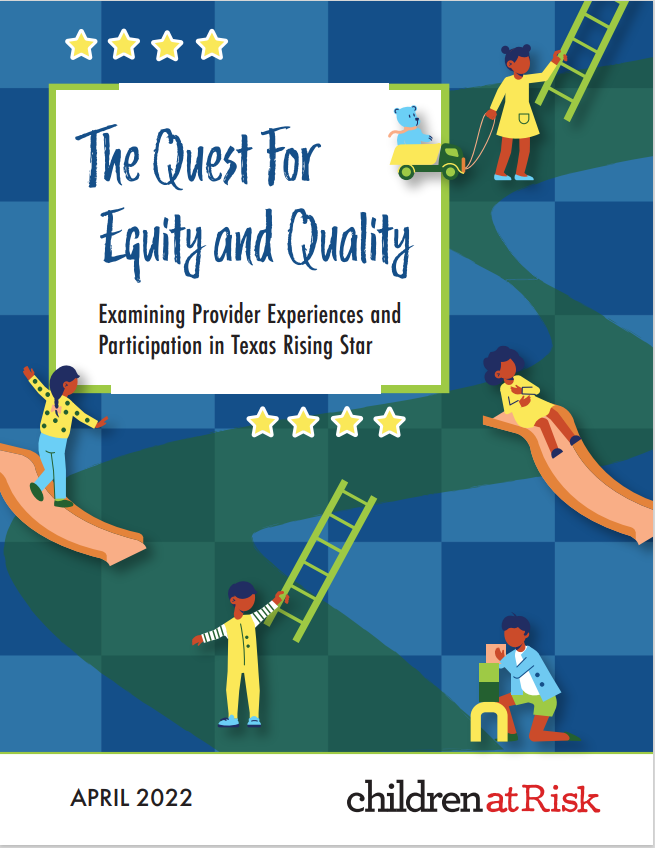
In the report, The Quest for Equity and Quality, CHILDREN AT RISK examines the experiences of early childhood education providers with TRS through a race equity lens. The report highlights the experiences of providers of color to understand potential race equity barriers preventing providers of color from being certified with TRS. Specifically, CHILDREN AT RISK seeks to understand the motivating factors for providers who choose to participate in TRS and those who do not by asking the following questions:
- Why are Early Childhood Education providers choosing not to participate in TRS?
- Why are providers of color not participating?
- Why are White providers not participating?
- Why are Early Childhood Education providers choosing to participate in TRS?
- Why are providers of color participating?
- Why are White providers participating?
CHILDREN AT RISK in partnership with Prairie View A&M University and the University of Houston conducted a Racial Equity Workforce Survey and held focus groups on TRS participation and racial equity to gain insight on the current Texas landscape. While our research sought to uncover the implications race had on TRS participation, the conversations centered around equitable access to supports and resources providers needed to be successful. In the report, we offer recommendations and policy solutions to streamline TRS enrollment and participation and create a high-quality child care environment for Texas children. There is a need to have continued discussions that allow for deeper conversations about race as an underlying factor in providing equitable access to ECE in Texas.
MORE LIKE THIS

Don’t Close the Door on Our Youngest Learners: Head Start Is Essential for Texas Children
As the Administration weighs the public comments in response to their recent Head Start Notice of Proposed Rulemaking, C@R's data team comments on the ways in which Head Start is actually essential for Texas children. Written by Christine Thomas...

Early Childhood Education & Childcare Testimony: House Committee on Trade, Workforce & Economic Development Hearing
Texas House Committee on Trade, Workforce & Economic Development HearingAugust 26, 2026Texas has a child care system that serves thousands of children and families every day. While the system is not perfect and there are important improvements...

Houston Child Care Sector Braces for Reduction in Subsidized Child Care Seats
Estimates indicate that upwards of a thousand Houston-area children are likely to no longer receive subsidized child care as state and federal changes place pressure on the sector. Media Contact:Morgan Gerri, 832.600.9354 TEXAS (August 27, 2026)...
C@R Testifies at Sunset Commission TWC Hearing
C@R Provides Testimony Focused on Opportunity Youth, Early Childhood, and Anti-TraffickingAugust 12, 2026CHILDREN AT RISK leaders Mandi Kimball and Kim Kofron provided public testimony before the Texas Sunset Advisory Commission during its August...

Fall 2026 Early Childhood Texas Tour
Each fall, CHILDREN AT RISK brings early childhood leaders and stakeholders together for community-centered conversations in 12 major Texas cities to exchange insights, examine regional experiences, and envision a stronger future for child care...

Press Conference: Child Advocates Discuss Proposed Head Start Overhaul and State-by-State Impacts
Notice of Proposed Rulemaking (NPRM) removes significant federal regulations, shifting most standards toward state and local regulation Media Contact:Morgan Gerri, 832.600.9354 TEXAS (August 13, 2026) – On Thursday, August 6, the U.S. Department of...