

Opportunity Youth & Young Adults
Recommendations for the Texas Sunset Commission Ahead of the 90th Texas Legislature
Related: Click here to read all of CHILDREN AT RISK’s recommendations for the Texas Sunset Advisory Commission.
Every 12 years, most Texas state agencies undergo a comprehensive review by the Sunset Advisory Commission, a process that includes staff analysis, public input, and legislative hearings. The Commission then makes recommendations to the Texas Legislature, which determines the agency’s future through passage of a Sunset bill. Agencies that are no longer needed may be abolished, while those requiring operational improvements may be restructured or directed to implement specific statutory or administrative changes.
The Sunset process offers a rare and powerful opportunity to shape the future of state policy. As one of the Legislature’s primary oversight tools, it is designed to hold state agencies accountable and ensure government remains effective, efficient, and responsive to the people of Texas.
CHILDREN AT RISK'S RECOMMENDATIONS
The following policy recommendations are intended to inform the Sunset Commission’s review of state agencies, programs, and investments affecting children, youth, and families in Texas. These recommendations emphasize evaluating the effectiveness of existing statutes and agency operations, assessing implementation and outcomes of enacted policies, and identifying statutory, regulatory, and administrative changes needed to improve efficiency, coordination, transparency, and accountability across state systems.
AREAS OF FOCUS INCLUDE:
- Opportunity Youth and Young Adults: Enhance cross-system alignment to expand career pathways, credential attainment, and workforce participation for youth 16-24 years.
- SNAP Employment & Training: Align policies to support eligible individuals access education and training programs that meet the state’s demand for skilled workers and reduce reliance upon public benefits.
Opportunity Youth & Young Adults Recommendations
Texas Workforce Commission
Texas Workforce Commission
Background: Young adults aged 16–24 represent the bridge between the education pipeline and Texas’ future workforce. However, many face significant barriers in this transition.
- Over 13% of Texans aged 16–24 are disconnected from school and work (“opportunity youth and young adult [OYYA]”).
- Many OYYA face challenges related to child welfare involvement, housing instability, mental health needs, or justice involvement.
- Services span multiple state agencies—including TEA, THECB, TWC, HHSC, DSHS, DFPS, TJJD, and TDHCA—each with differing eligibility criteria, funding streams, and data systems.
The result is a fragmented landscape that makes it difficult for OYYA to access consistent, coordinated support. Establishing a formal interagency subcommittee would improve systems alignment, reduce duplication, and enable more effective investments in the next generation of Texas workers.
Recommendation 1: Create subcommittee or advisory committee focused on supporting Opportunity Youth & Young Adults (OYYA) (ages 16–24 not in school, training, or employment) across agencies. Appointments from: the Governor, Lieutenant Governor, Speaker of the House, Members include THECB, HHSC, DSHS, TJJD, and TWC Chair serves as Advisory Chair. Include 1-2 spots for Opportunity Youth and/or parents of OYYA.
The committee will explore and advise Commissioners on how to strengthen coordination among human services, education and training for youth 16-24 in order to have a strong and healthy workforce. Identify braided funding strategies that align workforce, education, and human services programs, allowing young adults to receive support without gaps or conflicting requirements. Additional details will be developed (i.e. creation and abolishment dates for committe, reporting structure).
Recommendation 2: Texas needs a single, accountable point of contact to prevent youth disconnection (ages 16–24 not in school, training, or employment) and to coordinate reengagement across education, workforce, justice, and health systems. An ombudsman would provide leadership, problem-solving, and transparent reporting focused on reconnecting “opportunity youth.” Create in statute a Youth Disconnection Prevention & Reengagement Ombudsman within TWC, appointed by the Governor, reporting to the TWC Executive Director, with a pre-determined term, authority to coordinate statewide strategy, and required annual public reporting to the Legislature. Ombudsman will collaborate formally with TEA, THECB, HHSC, DFPS, TJJD, local workforce boards, and CBO’s. Core duties include developing statewide strategies, promoting cross-agency coordination, program development, and data dissemination. Ombudsman will be responsible for reporting annually to the Legislature on performance metrics such as: OYYA metrics: education reconnection (i.e.school re-enrollment rate, credential attainment, program enrollment), workforce/employment metrics (i.e.earnings rate, employment rate, employer engagement), support metrics (i.e.housing, access to insurance, food support), cross-system metrics (i.e.OYYA served by more than one agency, reduction in services or duplication of services, agency referrals), and long-term impacts (i.e.decrease in disconnection rate for OYYA).
Recommendation 3: Ensure the state’s workforce plan explicitly defines measurable goals, targeted strategies, and performance indicators to enhance access to workforce opportunities and improve outcomes for low-income and underserved Texans, particularly those served under the Workforce Innovation and Opportunity Act (WIOA).
Recommendation 4: Advance two-generational strategies throughout the Tri-Agency and related state systems to streamline services and strengthen outcomes for individuals and families.
Recommendation 5: Require TWC to partner with the Texas Education Agency to develop a mechanism to target schools with the highest need for vocational services for students who are transitioning from school to work.
Background: Across the state there are an estimated 500,000 youth between the ages of 16-26 who are not plugged in to school, post-secondary and work or who are systems involved. This population is shared across multiple agencies, yet we have not clear understanding of how many are served through any of these agencies and therefore cannot determine how effective we are in supporting them. Furthermore, this population is uniquely challenged with eligibility because they often face housing insecurity, foster care and other conditions that have limited their ability to obtain state identification and paperwork to determine elgibility for services.
We recommend four specific actions to better optimize support for this age group with existing resources and in anticipation of potential block grants in skills development funneling through the Texas Workforce Commission.
Recommendation 1: TWC to create a discreet definition for this age group of youth and young adults in order to better track progress and assess resources for this population. The specifically the definition for this population would be: between the ages of 16-26 who are not in school, not in postsecondary and not working OR who are systems involved (DFPS, HHS, TJJD).
Recommendation 2: All agency recipients of youth service funding would be required to provide publicly available unduplicated counts of youth served. Agencies serving youth concurrently (i.e. TWC and DFPS) are required to report how many of this age range that they share.
Recommendation 3: Simplify the eligibility determination process for youth in youth- serving agency programs through the following actions:
1. Develop “fast track” eligibility requirements for income-based eligibility such as evidence from year prior tax records and extend “self-attestation” protocols to 90 days.
2. Provide free and expedited processes to obtain state identification cards for eligible work.
Recommendation 4: Alignment of both agency and workforce investment board occupational priorities with new apprenticeship and work-based learning priorities emerging both through national and state assessments.
Health & Human Services
Health & Human Services
Background: Texas continues to face a significant challenge in serving Opportunity Youth and Young Adults (OYYA), individuals ages 16 to 24 who are disconnected from education and employment and often experience complex behavioral, social, and mental health needs. Many of these youth have histories of involvement with the Department of Family and Protective Services (DFPS) or the juvenile justice system, and they frequently encounter barriers to achieving educational or economic stability.
The Health and Human Services Commission (HHSC) reaches this population through several programs, including the Youth Empowerment Services (YES) Waiver, the Youth Crisis Outreach Team (YCOT), Community Resource Coordination Groups (CRCGs), and Peer and Family Support Services. While these programs provide critical behavioral health and crisis support, there is no unified framework within HHSC to identify, track, or report outcomes for OYYA across systems. Current data collection primarily measures service utilization and behavioral outcomes (e.g., crisis encounters, functional improvements, or family stability), but does not consistently capture long-term transition outcomes, such as educational attainment, workforce participation, or stable housing, that are essential to understanding and improving OYYA success.
Recommendation 1: For Youth Empowerment Services (YES), Youth Crisis Outreach Teams (YCOT) and peer programs, extend eligibility from age 18 to age 24 and align with workforce, housing, and higher education supports.
Recommendation 2: Current CRCG data systems and performance measures do not specifically capture outcomes for Opportunity Youth and Young Adults (OYYA), individuals ages 16–24 who are disconnected from school and work, often with overlapping behavioral health, housing instability, or justice involvement. Without tracking outcomes for this population, the state lacks visibility into how well CRCGs support OYYA transition goals such as education completion, job training, and sustained stability.
Embed OYYA indicators into CRCG reporting tools and performance dashboards, tracking outcomes such as educational re-engagement, workforce participation, housing stability, and behavioral health access. In doing this, CRCG operations would help align local coordination efforts with state priorities for workforce readiness, behavioral health, and community reintegration. Example of OYYA metrics: education reconnection (i.e. school re-enrollment rate, credential attainment, program enrollment), workforce/employment metrics (i.e. earnings rate, employment rate, employer engagement), support metrics (i.e. housing, access to insurance, food support), cross-system metrics (i.e. OYYA served by more than one agency, reduction in services or duplication of services, agency referrals), and long-term impacts (i.e. decrease in disconnection rate for OYYA) .
Department of Family and Protective Services
Department of Family and Protective Services
Background: Youth and young adults served by DFPS, particularly those transitioning out of foster care or involved in extended care, often face significant barriers to stable employment and self-sufficiency. Many lack access to career pathways, industry-recognized credentials, and postsecondary supports that are critical for long-term economic independence. While DFPS administers transition and independent living programs, formal coordination with the Texas Workforce Commission (TWC), Texas Higher Education Coordinating Board (THECB), and community colleges remains limited and inconsistent across regions. Without statutory requirements for structured collaboration, opportunities for career development, credentialing, and job placement are not fully leveraged for youth exiting care.
Recommendation: Direct the Department of Family and Protective Services (DFPS) to strengthen interagency coordination with the Texas Workforce Commission and the Texas Higher Education Coordinating Board, in collaboration with Local Workforce Development Boards and community colleges, to expand access for former foster youth to industry-recognized credentials, apprenticeships, and certificate programs aligned with regional workforce needs. Prioritize enrollment in programs eligible for Workforce Innovation and Opportunity Youth and Young Adult (OYYA) funding, and require reporting to the Legislature on standardized OYYA education, workforce, support, cross-system coordination, and long-term outcome metrics.
Department of State Health Services
Background: Opportunity Youth and Young Adults (OYYA), youth who are 16-24 and not in school or employed, represent an untapped potential workforce. In Texas, an estimated 470,000 young people fall into this category. They are often involved across multiple systems and have complex needs, including barriers such as lack of transportation, childcare responsibilities, housing instability, and limited access to mental health services. Meanwhile, especially in rural areas of Texas, health care systems are in desperate need of more health care workers. Young people, with the proper support and training, could fill the need for this growing industry, improving the provision of healthcare throughout the state while simultaneously creating stable career pathways that offer living wages and advancement opportunities.
Currently, OYYA face fragmented support systems as they age out of various state services, often losing critical resources at precisely the moment they need them most to transition into adulthood. The lack of coordinated workforce development strategies specifically designed for this population means Texas is missing a crucial opportunity to address both youth unemployment and healthcare workforce shortages. By leveraging existing interagency partnerships and expanding career pathways in public health, Texas can transform a population often viewed through a deficit lens into a vital component of the state’s healthcare infrastructure.
Recommendation 1: Expand public health career pipelines to include OYYA through paid apprenticeships, community health worker training, and targeted recruitment partnerships with LWDBs, reentry programs, and CBOs.
Recommendation 2: Strengthen collaboration and develop interagency transition plans and wraparound supports for OYYA youth aging out of Maternal & Child Health (MCH), foster care, and juvenile systems, ensuring continuity in healthcare, mental health, and vocational services.
Department of State Health Services
Department of State Health Services
Background: Opportunity Youth and Young Adults (OYYA), youth who are 16-24 and not in school or employed, represent an untapped potential workforce. In Texas, an estimated 470,000 young people fall into this category. They are often involved across multiple systems and have complex needs, including barriers such as lack of transportation, childcare responsibilities, housing instability, and limited access to mental health services. Meanwhile, especially in rural areas of Texas, health care systems are in desperate need of more health care workers. Young people, with the proper support and training, could fill the need for this growing industry, improving the provision of healthcare throughout the state while simultaneously creating stable career pathways that offer living wages and advancement opportunities.
Currently, OYYA face fragmented support systems as they age out of various state services, often losing critical resources at precisely the moment they need them most to transition into adulthood. The lack of coordinated workforce development strategies specifically designed for this population means Texas is missing a crucial opportunity to address both youth unemployment and healthcare workforce shortages. By leveraging existing interagency partnerships and expanding career pathways in public health, Texas can transform a population often viewed through a deficit lens into a vital component of the state’s healthcare infrastructure.
Recommendation 1: Expand public health career pipelines to include OYYA through paid apprenticeships, community health worker training, and targeted recruitment partnerships with LWDBs, reentry programs, and CBOs.
Recommendation 2: Strengthen collaboration and develop interagency transition plans and wraparound supports for OYYA youth aging out of Maternal & Child Health (MCH), foster care, and juvenile systems, ensuring continuity in healthcare, mental health, and vocational services.
SNAP Employment & Training Recommendations
Cross Agency recommendations for TWC & HHSC
Background
Background: In Texas, SNAP recipients aged 16-59 are required to participate in the SNAP Employment & Training program (SNAP E&T) unless they qualify for an exemption or are already working 30+ hours per week.
While the stated goal of SNAP E&T is to “help SNAP recipients get jobs and become self-sufficient,” HHSC’s self-evaluation report acknowledges SNAP E&T “participation levels are not at acceptable levels, and sanction levels are much higher than desired.” The small fraction of participants who do complete their assigned E&T component (less than 5%) earn median quarterly wages of approximately $4,500 — below the monthly income limit for an individual to maintain SNAP eligibility. This means that even those individuals that complete their assigned training activities are not reaching self-sufficiency. That data confirms that without access to credential-based training and career pathways, most participants land back in the same place within a year and miss out on high-demand opportunities within the Texas workforce.
Currently, Texas requires SNAP E&T participants to engage in 30 hours of training per week, which exceeds the standard federal requirement (20 hours per week) and creates a mismatch between policy/regulations and the structure of most workforce training programs. Many qualified and proven workforce development organizations are prevented from participating in Texas’s SNAP E&T program because their nationally-recognized curricula do not meet the 30 hour/week threshold. In addition, Texas has the opportunity to recognize “credentials of value” (HB 8 (88R), SB 1786 (89R)) as being “equivalent to SNAP E&T”, which would allow students enrolled in those programs to satisfy SNAP work requirements with their coursework, which by definition, must lead to a self-sufficient wage.
Texas’ SNAP E&T program is currently failing to help eligible individuals access education and training programs that meet the state’s demand for skilled workers and reduce reliance upon public benefits. Aligning Texas’ requirements with the federal standard could reduce confusion, lower administrative burden, and improve participation and outcomes in SNAP E&T. In addition, Texas could better leverage community colleges and other workforce partners, which are already equipped to provide industry-aligned training and support, to improve completion, connect participants to credentials, and strengthen economic mobility.
Recommendation 1
Recommendation 1: Direct HHSC (in collaboration with TWC and THECB) to define and identify postsecondary programs that are “equivalent to SNAP E&T” components to ensure students enrolled in “credentials of value” have their coursework recognized as satisfying SNAP’s work requirements. This will improve completion rates for students and lead to greater self-sufficiency post-credentialing.
Recommendation 2
Recommendation 2: Direct TWC and HHSC to develop and implement standardized contracting and reimbursement models for third-party SNAP E&T providers to be applied across all local workforce development boards & set ambitious goals to scale the number of third-party partners contracted to provide SNAP E&T, with an emphasis on community colleges and other credential-based training providers.
Recommendation 3: Require HHSC to align SNAP E&T program requirements with the federal baseline (20 hours per week/80 hours per month) to simplify compliance, reduce administrative complexity, and support more consistent program engagement.
Recommendation 4: Develop a statewide SNAP E&T provider dashboard tracking key program metrics, including enrollment, completion, job placement, and job retention.
Recommendation 3
Recommendation 3: Require HHSC to align SNAP E&T program requirements with the federal baseline (20 hours per week/80 hours per month) to simplify compliance, reduce administrative complexity, and support more consistent program engagement.
Recommendation 4: Develop a statewide SNAP E&T provider dashboard tracking key program metrics, including enrollment, completion, job placement, and job retention.
Recommendation 4
Recommendation 4: Develop a statewide SNAP E&T provider dashboard tracking key program metrics, including enrollment, completion, job placement, and job retention.
Agencies Under Review
2026-2027 Review Cycle – 90th Legislative Session
- Texas Workforce Commission
- Department of Family and Protective Services
- Texas Juvenile Justice Department
- Health and Human Services Commission
- Department of State Health Services
Agencies Under Review
2027-2029 Review Cycle – 91st Legislative Session
- Texas Education Agency
- Texas Higher Education Coordinating Board
MORE LIKE THIS

Early Childhood Education & Childcare Testimony: House Committee on Trade, Workforce & Economic Development Hearing
Texas House Committee on Trade, Workforce & Economic Development HearingAugust 26, 2026Texas has a child care system that serves thousands of children and families every day. While the system is not perfect and there are important improvements...
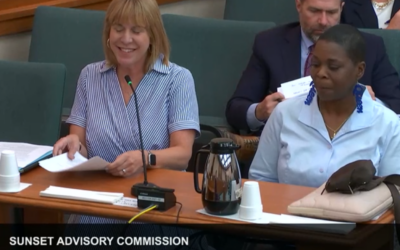
C@R Testifies at Sunset Commission TWC Hearing
C@R Provides Testimony Focused on Opportunity Youth, Early Childhood, and Anti-TraffickingAugust 12, 2026CHILDREN AT RISK leaders Mandi Kimball and Kim Kofron provided public testimony before the Texas Sunset Advisory Commission during its August...

Systems-Change for the Next Generation: Recap of the Child Safety, Security & Opportunity Summit
Written by Lucy Lusk, Summer 2026 Media Fellow, CHILDREN AT RISK On July 16th, CHILDREN AT RISK hosted their 2026 Child Safety, Security, and Opportunity Summit: Systems-Change for the Next Generation. With the support of our incredible sponsors,...

Public Comments on the Sunset Advisory Commission Staff Report: Texas Workforce Commission
July 2, 2026 - CHILDREN AT RISK appreciates the Sunset Advisory Commission staff review of the Texas Workforce Commission (TWC). The staff report describes ways to strengthen the administration, accountability, transparency, technology...
2026 Human Trafficking Sunset Recommendations
Related: Click here to read all of CHILDREN AT RISK’s recommendations for the Texas Sunset Advisory Commission.Every 12 years, most Texas state agencies undergo a comprehensive review by the Sunset Advisory Commission, a process that includes staff...

2026 Early Childhood Sunset Recommendations
Related: Click here to read all of CHILDREN AT RISK’s recommendations for the Texas Sunset Advisory Commission.Every 12 years, most Texas state agencies undergo a comprehensive review by the Sunset Advisory Commission, a process that includes staff...
Get Involved
Our vision is for the state of Texas to be the best possible place for children to grow and families to work. CHILDREN AT RISK’s policy team works tirelessly to listen to community needs and advocate for public policy that truly supports children and families.
Stay in touch! Sign up for our Newsletter today to receive monthly updates on the latest research, convenings, and advocacy opportunities.
Questions? Contact us at info@childrenatrisk.org.